
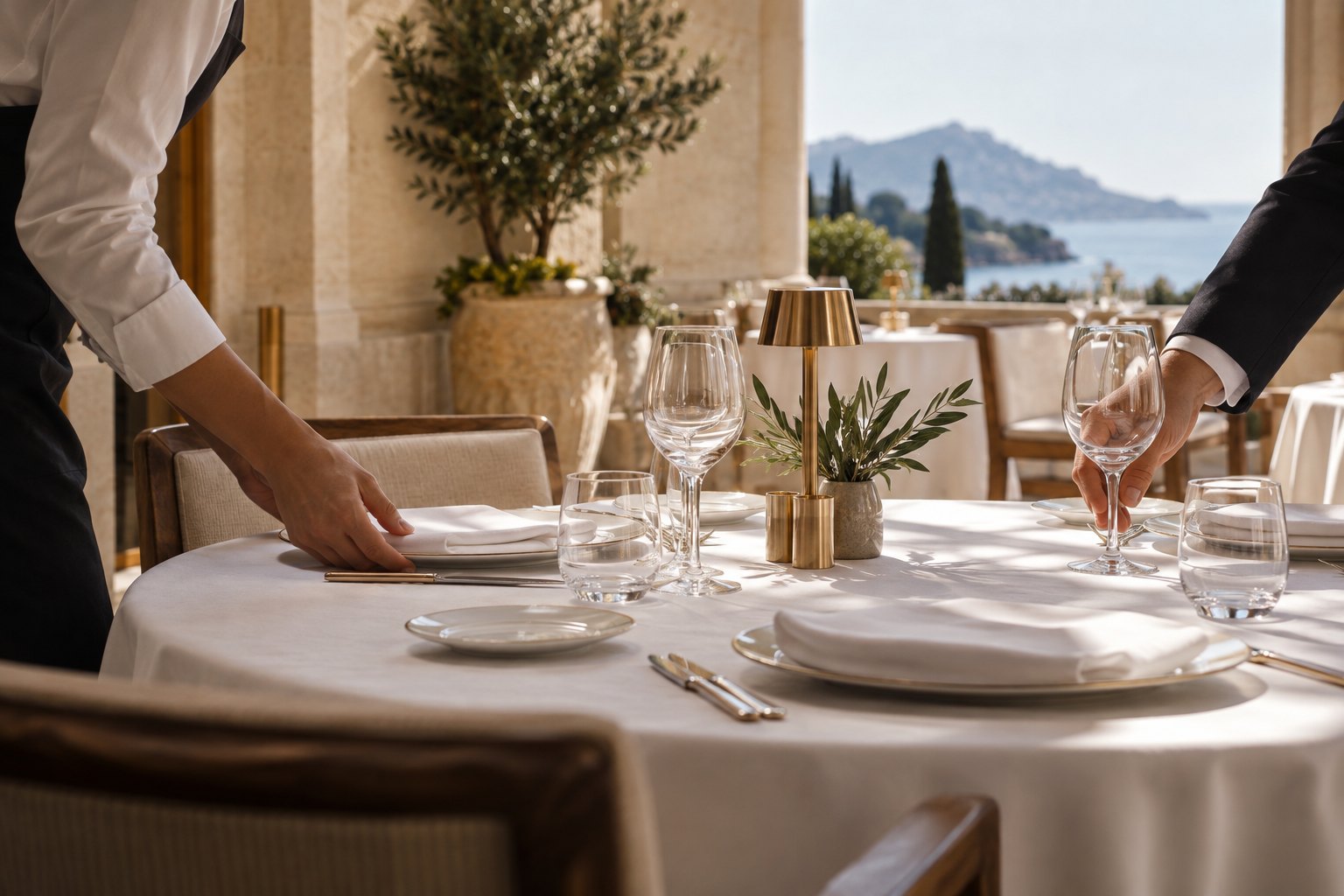
These facts only confirm how important it is to recognise these trends and focus on excellence in the food and beverage department of the modern hotel industry.
The basic distinction in food service is between the “buffet” and “à la carte” concepts. The “buffet” concept, popularly known in Croatian as a “Swedish table”, is organised so that food is presented in appropriate containers or on stands and guests are free to choose what they want. Depending on whether the food is hot or cold, we can speak of hot and cold buffets. An “à la carte” offer is organised so that guests choose food from a menu, which is then prepared specifically for them and brought to their table.
For those who do not even want to leave their room at mealtimes, “room service” is available to deliver food to the room in an appropriate manner.
In theory, provided food in a “buffet” is held appropriately, the quality of food in “buffet” and “à la carte” concepts is exactly the same. The only difference is the type of service. If you do not want to queue and serve yourself from a dish but would prefer someone to serve you, then “à la carte” is the concept for you. This in itself places greater demands on the hotel and incurs higher costs, resulting in a higher final price for the guest.
When we discuss differences within the “buffet” concept, the basic differences lie in the quality of the ingredients and the breadth and depth of the food offer.
The classic “à la carte” approach is characterised by the usual style of service, in which guests are free to choose absolutely anything from the menu and the food is then served in the order they wish.
A meal served in courses follows a set sequence of dishes from which guests may choose what they want, except in a fixed tasting menu. The number of courses is not always the same and may vary according to the type of cuisine — Italian, French, Lebanese and so on — and the quality of the restaurant. Generally speaking, guests choosing a meal in courses can first expect an amuse-bouche, whose purpose is to “awaken” their palate and appetite. The amuse-bouche itself depends on the chef’s inspiration and is often presented as a gift from the chef to the guest. The next dish has the character of a starter, of which there may be several, and may be hot or cold. To prepare the guest’s palate for the main course after the starter, a sorbet is brought to the table. The sorbet should be cold, sweet and refreshing. It is followed by the main course, which is the central focus of a meal served in courses. In many fine dining restaurants, there is an unwritten rule that every main course delivered to the table must be checked, meaning the guest must be asked whether they are satisfied with it. Dessert follows the main course and, depending on the occasion, it may be followed by something sweet, such as a petit four, or something savoury, such as a selection of cheeses.
Among the more important trends, I would highlight vegetarian, vegan and gluten-free menus, the growing attention paid to various food intolerances and allergies, and the “zero waste” concept.
As for drinks, an aperitif before the meal and a digestif afterwards are always suggested. During the meal, recommendations include wine — suitable for fish or meat, dessert wine or sparkling wine — other appropriate alcoholic drinks and various mixed drinks. Water and juices are options for guests who do not drink alcohol, while various coffee-based drinks and teas form the foundation of the hot drinks offer.
The person with overall responsibility for food and beverage service is known as the “maître d’”, or dining room manager. The “head waiter” leads the waiting staff and has a supervisory role. The person responsible for a particular section of tables is the “chef de rang”, or section waiter. The person responsible for bringing food and drinks to the table is the “food runner”, and the person responsible for working behind the bar is the “bartender”.
To understand the complexity of the food and beverage department as a whole, we need to take a step back and understand the hierarchy within the kitchen itself.
Here we find the “head chef”, the central authority in every kitchen; the “sous chef”, the head chef’s right-hand person; the “chef de partie”, responsible for a particular section of the kitchen, such as the grill or pastry; the “commis chef”, a junior chef; the “kitchen porter”, a kitchen assistant responsible for peeling potatoes and similar simple tasks; and the “dishwasher”.
For someone responsible for a hotel’s income and expenditure, it is very important to know that food and beverage is undoubtedly a high-risk department, exposed every day to the danger of generating unnecessary and enormous costs. Purchasing supplies at high prices and of questionable quality creates a major expense, but this is negligible compared with the cost of throwing away food because the required number of meals was planned incorrectly.
I will answer with a quotation from a well-known Croatian chef with whom I had the opportunity to speak.